As Novak Djokovic handed Kei Nishikori a loss in the Miami Open Final, this past Sunday in just under an hour and a half, the debate over his continued dominance's effect on the sport raged on. While some argue Novak is the most dominant player in tennis history, others argue on the question: is his dominance good for the game? Bleacher Report writer Merlisa Corbett argues that even if Djokovic's dominance bores some, in the long run, he's good for the game. Corbett makes a compelling argument, one to which I agree, as great players raise the bar and provide a blueprint for future stars to follow.
As Federer fades, Murray remains inconsistent (especially for his number two spot), and Nadal continues to struggle to regain his form, Djokovic keeps rolling through the ATP World Tour with little resistance. Despite Nishikori looking extraordinary as he dismantled Monfils and Kyrgios, he put up little resistance to world number one. Djokovic's overall game, both mentally and physically, is almost as perfect as can be. The excitement he brings to tournaments all over the globe allows fans to witness near-perfection and lay claim to living in the era of one of the game's most dominant players. As the era of the Big Four is seemingly coming to an end, not everyone is embracing Novak's superiority. With more points than No. 2 Murray and No. 3 Federer combined, Novak's created one of the largest margins in ATP history. Corbett notes that Djokovic's dominance is comparable to that of UCONN's women's basketball team. As tv ratings for the women's final were down 28% from the previous year, critics have created a sense of discomfort that comes with dominance. But dominance is nothing new to tennis, i.e. Federer and Bjorn Borg, even as critics poke more holes in Djokovic's game. Analysts of Djokovic's game speak of a "boring brand of tennis," but like Corbett points out, his game is far from boring. A highly-regarded well-rounded player, like Novak, is able to find a way to beat his opponents regardless of what they throw at him. The "next generation" of players on the tour can learn a lot from Djoko's game, as he dismantles players of all styles. With the ATP tour filled up with players of various styles, from big servers to serve-and-volley types, Djokovic proves it takes a variety to sustain his type of dominance. Rather than viewing it as a time of Nole, tennis should be seen as in "transition." With Djokovic there comes no doubts, like those that surround the other members of the Big Four, and as he continues to dominant fans will come around. Big stars like Djokovic, Steph Curry, and Payton Manning become as beloved as they are polarizing. Talent, excellence, and brilliance are always good for the game. The best is always better, even if it leads to dominance. Great players raise the bar and in the long run are good for the game.
Sunday, April 17, 2016

Wednesday, April 6, 2016
TOW #23 - IRB "Alan Turing: The Enigma"
The richly detailed 750-page biography of a mathematical genius and analysis of his ideas, might seem a daunting proposition. But fellow mathematician and author Hodges has acutely clear and often extremely moving insight into the humanity behind the leaping genius that helped to crack the Germans' Enigma codes during World War II and bring about the dawn of the computer age. The biography that inspired the movie, The Imitation Game, gives the reader so much more insight into the mathematical genius than a two and half hour movie ever could. The book begins with Turing's childhood, focusing in upon education at his public school, Sherbourne. Where his attitude of the school was very much classics first, this attitude seems to have been common and perhaps persists today. Turing was something of an erratic student, outstanding in the things that interested him (although not necessarily at all tidy) and very poor in those things that did not interest him. After Sherbourne he went to King’s College, Cambridge University on a scholarship for which he had made several attempts. The value of the scholarship, £80 per year, is quite striking; double the value of unemployment benefit and half that of a skilled worker. He started study in 1931, on the mathematics Tripos. His scholarship examination performance was not outstanding. Significant at this time is the death of his close school friend, Christopher Morcom in 1930. King’s is a notorious hotbed of radicals, and at this time Communism was somewhat in vogue, a likely stimulus for this was the Great Depression: capitalism was seen to be failing and Communism offered, at the time, an attractive alternative. Turing does not appear to have been particularly politically active though. Halfway through the detailed filled biography, and I cannot wait to discover more of this complex man, who contributed to the shortening of WWII by two years.
Sunday, April 3, 2016
TOW #22 - "Hollywood sexism in pointed new essay"
The differences between men and women go back to the beginning of time, from the lives we lead to the paths we take. Women are fighting to be heard more often in nearly every industry I can think of, yet the problems still exist. As Emma Watson writes in her open letter to the entertainment industry, "all I hear and see all day are men speaking their opinions, and I give mine in the same exact manner, and you would have thought I had said something offensive." Women are afraid to give their opinions, or to negotiate for fair pay in an industry dominated by powerful men. While the stigma that women are inferior still exists, it must be fought against in order for change to happen and for both sexes to be seen as equal. I'm not usually the outspoken feminist; however, feminism simply means believing that women should be given the same rights and have the same opportunities as men. Personally, this sounds pretty fair and obvious. Why should women who are working just as hard, and often even harder, than men be compensated less for their work? In addition, she highlights the difficulty she has attempting to negotiate for higher pay, because she doesn't want to come off looking like a "spoiled brat." This issue goes much beyond just getting equal pay, it is the stereotypes that are attached to powerful women. Women should not be raised to be soft spoken and submissive, simply because a man is taught to care less about what women have to say. Our sons must be raised to respect women and to see them as equals. Women in every industry should not be afraid of looking petty or un-thankful, just because they want to be treated fairly for the time and hard work they are putting into a job. Jennifer Lawrence makes a good point when she talks about feminism being a "trending" topic. It's often hard for these issues to feel important if all they feel like is temporary. However, the problem is not going away, and women have been treated as lesser to men for far too long.
Sunday, March 13, 2016
TOW #21 - Tips from Former Smokers Video
Sunday, March 6, 2016
TOW #20 - IRB "Alan Turing: The Enigma"
The richly detailed 750-page biography of a mathematical genius and analysis of his ideas, might seem a daunting proposition. But fellow mathematician and author Hodges has acutely clear and often extremely moving insight into the humanity behind the leaping genius that helped to crack the Germans' Enigma codes during World War II and bring about the dawn of the computer age. The biography that inspired the movie, The Imitation Game, gives the reader so much more insight into the mathematical genius than a two and half hour movie ever could. The book begins with Turing's childhood, focusing in upon education at his public school, Sherbourne. Where his attitude of the school was very much classics first, this attitude seems to have been common and perhaps persists today. Turing was something of an erratic student, outstanding in the things that interested him (although not necessarily at all tidy) and very poor in those things that did not interest him. After Sherbourne he went to King’s College, Cambridge University on a scholarship for which he had made several attempts. The value of the scholarship, £80 per year, is quite striking; double the value of unemployment benefit and half that of a skilled worker. He started study in 1931, on the mathematics Tripos. His scholarship examination performance was not outstanding. Significant at this time is the death of his close school friend, Christopher Morcom in 1930. King’s is a notorious hotbed of radicals, and at this time Communism was somewhat in vogue, a likely stimulus for this was the Great Depression: capitalism was seen to be failing and Communism offered, at the time, an attractive alternative. Turing does not appear to have been particularly politically active though. Halfway through the detailed filled biography, and I cannot wait to discover more of this complex man, who contributed to the shortening of WWII by two years.
Sunday, February 28, 2016
TOW #19 - "Face Blindness"
Facial recognition is a skill most of us have had since birth, a skill, given its commonplace nature, that we often take for granted. However, for some, this ability would seem completely foreign. Kate Szell, a former partner in a law firm, recently won a science writing contest on the subject of prosopagnosia, a condition that makes it extremely difficult for a person to recognize faces. She aims to spread awareness and foster an environment of understanding for those suffering from the condition. As even our smartphones are learning to recognize faces, it is difficult to imagine a world without such an ability. To compound the level of understanding obtained through the analogy, Szell also offers insight from a person who suffers from the condition. A fourteen-year-old girl tells about how she once asked her best friend of many years who she was. “[S]he’d had a haircut, so how was I to know?” (paragraph 1). The testimony gives her credibility on a personal level and makes her reader feel sympathy for those suffering from prosopagnosia. A simple level of emotional connection to a real case of the condition facilitates the level of acceptance and patience Szell hopes to achieve.
Beyond personal testimony, Szell provides the logical appeal through facts she has collected and expert testimony to the reality of the issue. According to studies, she writes, around two percent of the population has prosopagnosia (paragraph 3). While the percentage seems small, it is not. Out of every fifty people, one has prosopagnosia. Such as statistic helps her audience to see how vital understanding is. Most people interact with at least fifty people in their lives, so awareness of the condition should be much more widespread than it is. Kate Szell’s contest-winning essay certainly takes the prize for helping people to, in her own words, “recognize the face of prosopagnosia."
Beyond personal testimony, Szell provides the logical appeal through facts she has collected and expert testimony to the reality of the issue. According to studies, she writes, around two percent of the population has prosopagnosia (paragraph 3). While the percentage seems small, it is not. Out of every fifty people, one has prosopagnosia. Such as statistic helps her audience to see how vital understanding is. Most people interact with at least fifty people in their lives, so awareness of the condition should be much more widespread than it is. Kate Szell’s contest-winning essay certainly takes the prize for helping people to, in her own words, “recognize the face of prosopagnosia."
Sunday, February 21, 2016
TOW #18 - Apple vs. Africa visual

The powerful visual text juxtaposes the effect of the death of the iPhone vs. the death of the millions in Africa. The text claims that when one iPhone dies, million cry; while when millions in Africa die, no one cries. Society's attention is focused on the latest and greatest technology, rather the lives of millions in the African continent. When the first iPhone 6 in Australia was dropped on live television, it received millions of shares across social media and cringing from millions behind the screen. Society's obsession with the latest and greatest technology has people focused on all the wrong things. The simple dropping of an iPhone has witnesses waiting with worries, as the owner picks up their phone to reveal if they have or have not cracked their six hundred dollar phone. The author of this visual text brings up a very valid point, while one piece of technology dies emotions of sadness fill a person, but while millions of human lives are lost, those outside of the family don't shed a tear. Society has come to a point where it cares more about one single piece of technology, rather the human lives lost in another continent. We have become too fixated on innovative technology over the lives of those across the pond. True, it is hard to connect with people we've never met, but we've found ourselves attached to a little piece of metal. The author makes a valid point, society is focused on all the wrong things. Technology > Human Lives
Monday, February 15, 2016
TOW #17 - "Running Away with the Circus"
In “Running Away With the Circus”, Taffy Brodesser uses anaphora, and symbolism in order to share with the readers the lives of circus performers and the dying legacy of circuses. The author starts the article by introducing the different people involved with the Ringling Brothers Circus, a well-known circus that’s been around since 1884. He incorporates anaphora by beginning all the sentences in the first paragraph with “you could see (a person’s name)” and descriptions of them, such as their jobs or titles, then finish the sentence with what they do. For example, “You could see Edward Billings, the King of the High Stilts, as he confounded audience members with his height and balance” (1). With his use of anaphora, he is able to introduce his entire article with a satisfying rhythm and an interesting way of introducing the “characters”. Also in the beginning, the author tells the story of the first time people witnessed the light bulbs Thomas Edison had invented, and how amazed they were by the miraculous inventions. The light bulb, which became the symbol for the circus throughout the article, was the fresh and original idea that people were newly shocked by back then, but is now something that no one pays any attention to anymore, which is similar to the idea of circus. The author, when talking about the reasons behind the decline of popularity in circuses, states, “maybe they don’t have their new light bulb yet, but they already have a lot to work with” (20). This shows that although they haven’t found the one thing or idea that today’s people will be amazed over yet, they are still working on developing new and improved ideas to please their audiences. With his use of anaphora and symbolism, Brodesser is able to successfully share the stories of circus performers and their dying legacies.
Sunday, January 31, 2016
IRB Intro #3
The Intimation Game, a WWII movie on the team at Bletchley Park that cracked the German Enigma and won the war, became quite popular in 2015 and won multiple nominations at the Oscars and BAFTAs. But the man behind the story, Alan Turing, was only captured in a summarizing detail. I found that the movie had been adapted off of the book Alan Turing: the Enigma by Andrew Hodges. The movie had gone to share part of the childhood of Turing, focusing on his friendship with Christopher, but had mainly focused on his time surrounding Bletchley Park. The movie was quite fascinating, and in my opinion deserved more than just one Oscar, but what had truly captured my full interest was a caption that appeared at the end of the movie. Turing's machine, which had cracked the German code, paved the way for the invention of the computer. This is why I have chosen to take the challenge of reading the 700+ page novel.
Sunday, January 24, 2016
TOW #16 - "NYC grinds to a halt amid deadly East Coast blizzard"
#Snowpocalypse Jonas touched down on the northeast coast on Friday afternoon. Starting in DC on Friday at noon, the blizzard raged through up the coast. The massive winter storm ground life to a halt, as upwards on 3 feet of snow accumulated on the grounds. Jonas even forced a vehicle travel ban in New York City. The storm also closed rail/subway service and shut down theaters as higher-than-forecast snowfall inundated the metropolitan area. USA Today writer, Kevin McCoy, reported on life in the Big Apple as the second-largest storm in city history raged on. As it raged into late Saturday night, the storm proved deadly as three had snow shovelers died of apparent heart-related injuries, according to the chief of the NYPD. New York governor Andrew Cuomo announced the travel ban during an afternoon briefing after he issued an emergency declaration for southeastern New York. The ban applied to all motor travel, except for government or medical emergency vehicles. Beginning at 2:30 pm, New Yorkers who braved the snow had to travel by foot on the vehicle-free streets. NYC Mayor Bill de Blasio warned, "If you're a citizen out driving, you will be subject to arrest." But NYC is full of rule breakers, as filmmaker Casey Neistat and friends equipped their Jeep with cables out the back; equipped for pulling snowboarders. Neistat took the opportunity of somewhat cleared streets and empty roads to snowboard while attached to the moving car. The vehicle-free streets were not free of people though, as many New Yorkers spotted Neistat boarding through Times Square and other parts of NYC. NY's unique aura shined through Neistat and friends, as nothing, not the travel ban nor the NYPD they encountered, stopped them from having the time of their lives. With the storm passed, east coasters are left to shovel their ways back to everyday life, as the first snowfall of winter brought massive piles of the white "dust."
Sunday, January 17, 2016
TOW #15 - "In Plain English: Let's Make It Official"
The essay "In Plain English: Let's Make It Official" first appeared in 2006's Time magazine. In it, author Charles Krauthammer states his view on whether or not English should be deemed the official language of the United States. He argues that it should, through his personal anecdotes and acknowledgement of the other side allows him to do so effectively. In the beginning, Krauthammer introduces himself as a bilingual man who grew up in Canada, a country that, "of course, had no choice about bilingualism [...] The U.S., by contrast blessed with a single common language for two centuries, seems blithely and gratuitously to be ready to import bilingualism with all its attendant divisiveness and antagonisms". He establishes a credibility by explaining his upbringings in a country divided by language, and contrasts it to the US which is ready to tear itself apart by bringing in this bilingualism, even though they have this opportunity to be united under one language. He then goes on to explain his view completely; that it is okay to be bilingual and practice other languages, but it is not okay to demand the U.S. government adhere to that language. When immigrating to the U.S., "the immigrant, of course, has the right to speak whatever he wants. But he must understand that when he comes to the U.S., swears allegiance and accepts its bounty, he undertakes to join its civic culture. In English". He makes a compelling and logical argument by appealing to the other side. He does not say, "You need to speak English fluently, and English only", which may be the fears of many opposing the term official language in regards to the relationship between the United States and English. He basically says, "You need to understand enough English to participate in our society, where our official documents will be printed in English." Krauthammer effectively argues his opinion that English should be the official title of the United States though personal anecdotes and addressing the other side of the argument in "In Plain English: Let's Make It Official."
Sunday, January 10, 2016
TOW #14 - WFP PSA
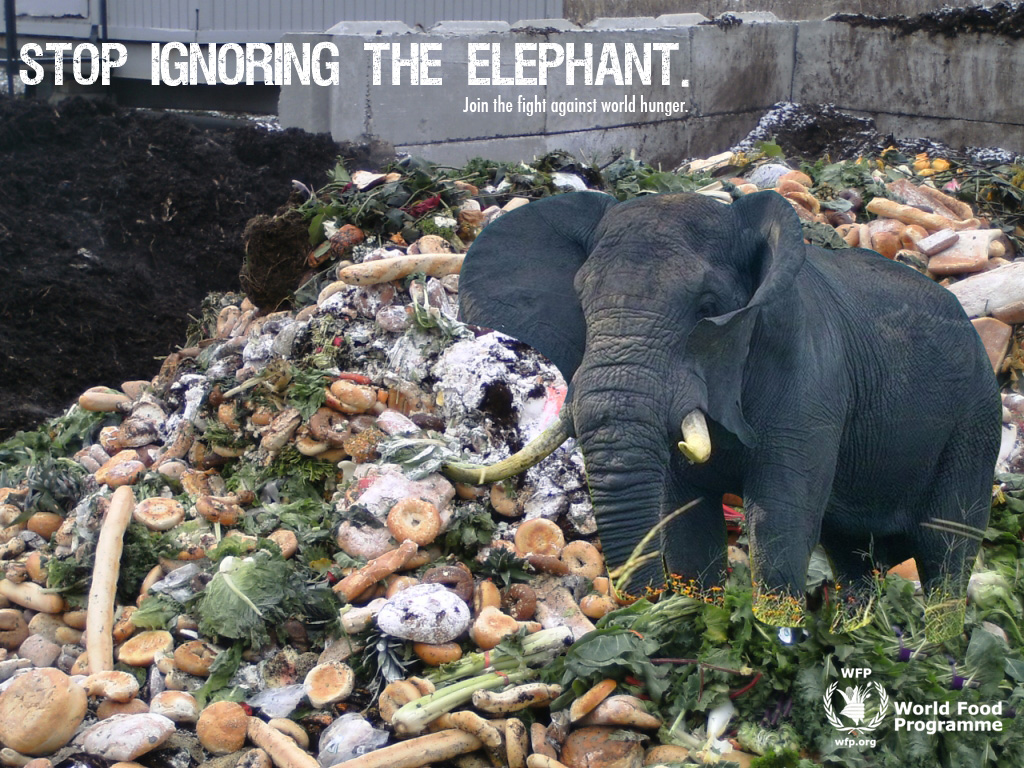
The World Food Programme has worked to aide countries with hunger problems since it was established in 1961, and with this ad they aim to draw attention to the cause. The use of several rhetorical devices, including contrasting images and an allusion, helps grab the audiences attention and sparks an interest or at least a glance towards aiding world hunger. Clearly, the elephant front and center grabs the viewer's attention. Initially, the viewer might believe this is an ad for the WWF (World Wildlife Fund), which often times uses cute animals to help their cause in aiding animals globally. However, the WFP is not specifically concerned with animals, but more malnutrition issues. The elephant stands in a enormous pile of food, which goes along with their mission of ending world hunger. The two contrasting images, ideas, and causes makes the reader wonder, "Why is an organization using something unrelated to their cause coupled with the exact reason for their cause to prove their point?" The allusion then connects the dots for the audience, in which the text states, "Stop ignoring the elephant. Join the fight against world hunger." This is an allusion to the well-known saying, "we must address the elephant in the room." It is inferable that the elephant in the room is world hunger, and the World Food Programme wants the audience's attention and concern on this important issue. Essentially, the WWP wanted the audience to address the elephant in the picture. The WWP grabs the audience's attention with an allusion to the elephant that contrasts with their purpose and effectively highlights the concern the audience should have on the issue of world hunger.
Subscribe to:
Posts (Atom)