Sunday, January 10, 2016

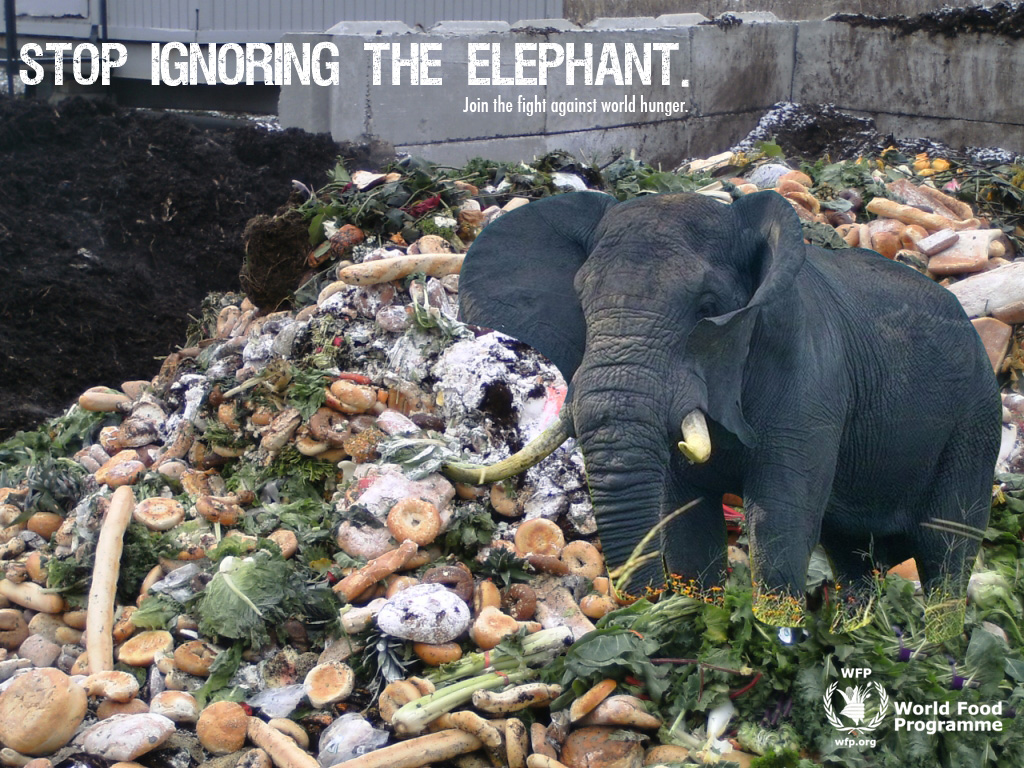
TOW #14 - WFP PSA

The World Food Programme has worked to aide countries with hunger problems since it was established in 1961, and with this ad they aim to draw attention to the cause. The use of several rhetorical devices, including contrasting images and an allusion, helps grab the audiences attention and sparks an interest or at least a glance towards aiding world hunger. Clearly, the elephant front and center grabs the viewer's attention. Initially, the viewer might believe this is an ad for the WWF (World Wildlife Fund), which often times uses cute animals to help their cause in aiding animals globally. However, the WFP is not specifically concerned with animals, but more malnutrition issues. The elephant stands in a enormous pile of food, which goes along with their mission of ending world hunger. The two contrasting images, ideas, and causes makes the reader wonder, "Why is an organization using something unrelated to their cause coupled with the exact reason for their cause to prove their point?" The allusion then connects the dots for the audience, in which the text states, "Stop ignoring the elephant. Join the fight against world hunger." This is an allusion to the well-known saying, "we must address the elephant in the room." It is inferable that the elephant in the room is world hunger, and the World Food Programme wants the audience's attention and concern on this important issue. Essentially, the WWP wanted the audience to address the elephant in the picture. The WWP grabs the audience's attention with an allusion to the elephant that contrasts with their purpose and effectively highlights the concern the audience should have on the issue of world hunger.

Sunday, December 20, 2015

TOW #13 - IRB "The Man Who Loved Books Too Much"

In "The Man Who Loved Books Too Much," Allison Hoover Barlett writes about book thief John Gilkey. Ken Sanders, a Salt Lake City rare book dealer, has been chasing down the thief for years, and finally catches a break by learning his name and receiving a mug shot several days before an antique book fair in New York City. Her perspective as an outsider, a journalist interested in the case, makes readers trust her words. Barlett had initially written an article for her San Francisco magazine to cover this topic, but eventually it gathered large enough interest to create a book. She begins by illustrating her experience at the fair, and how she stalked out Sanders, and quotes him throughout her narrative of their conversation. She also met with Gilkey as he was in prison for bad checks, helping her appeal to ethos as she shows both sides of the story. She shows Gilkey's literary obsession, and his questionable mental state, without painting him as the villain and Sanders as the hero. She shows the views of those Gilkey affected and those who were after him, as well as Gilkey himself. She is constantly in the middle herself, and she shows that by describing the struggle she has between the moral responsibility she feels to tell the authorities of his crimes, and the lack of technical legal responsibility she has to do so. This appeals pathos in a way as it evokes feelings of pity and understanding from readers. Halfway through the book, I have yet to discover a concrete purpose from Barlett. But I find possible hints to it, as she finds it important to show both sides of the story and the fact that everyone has a reason behind what they do, even herself.

Sunday, December 6, 2015

TOW #11 - "Knoxville: Summer of 1915"

In "Knoxville: Summer of 1915", James Agee describes the time in his life when he was a “new plate,” before he became damaged. His credibility comes from the fact that he is depicting his own life, and allowing himself to bring intense emotion into the piece. Before the reader can begin to understand Agee's purpose, one must recognize that this piece was not meant to stand alone; but it is an introduction for "A Death in the Family", an anecdote about the death of his father. Now it becomes quite clear, the story of his childhood is meant for anyone that will listen to his story. A story about a simpler and more innocent time in his childhood, before it all became rotten. Agee depicts an extremely average summer night in Knoxville, where nothing exciting happened, yet everything was peaceful and he was content with the world and his family. To achieve his purpose, Agee uses specific diction. It illustrates how a little boy would think and act, which allows the reader to connect emotionally with a young Agee and really step into the time period of his life that he is describing. This helps the reader understand the purity of youth by reading about it firsthand. Symbolism also plays a huge part in helping Agee achieve his purpose to depict the innocence of his childhood. He writes, "those who receive me, who quietly treat me, as one familiar and well-beloved in that home: but will not, oh, will not, not now, not ever, but will not ever tell me who I am" (Agee 175). Knowing oneself and being comfortable in one's skin is sign of maturity, whereas on the other hand having to be told who you are is a sign of naivety and youth. This really solidifies his purpose of showing innocence and purity in the context of the daily life of a young James Agee. Agee expertly aides his audience in understanding the innocence of his youth before corruption in "Knoxville: Summer of 1915".

Sunday, November 22, 2015

TOW #10 - "Novak Djokovic Ascends Ever Higher, With No Clear Landing in Sight"

As the 20,000 present at the 02 watched Roger Federer double-fault for the second time in the match, Novak Djokovic claimed victory at the Barclay's ATP World Finals. With almost 7,000 points separating Djokovic from no. 2 Andy Murray, it is clear he sits a whole class apart from the rest of the field. In the eleven month season, the 28 year old no. 1 was able to end the year with three grand slam titles, a defeat in the French Open final, six Masters titles, the Finals title and an 82-6 win-loss record. New York Times writer Christopher Clarey utilizes statistics and complimentary diction to tell of "Novak Djokovic's finest season." Clarey shares stats of Djokovic's game throughout to put into perspective one man's dominance over an entire field. "Djokovic [has] more top-10 victories in a season than any other men’s player in the Open era. Over his career, Djokovic’s winning percentage against the top 10 is 66.1 percent (65.5 percent for Nadal, 65.4 percent for Federer)." The author makes obvious appeals to logos, as readers are able to understand how outstanding his game must be, especially with the comparison to his fellow 'Big Four' members. Through his successful use of statistics, readers are able to grasp how this must truly be Nole's finest season. In a span of eleven months, only four (with a combined six wins between them) were able to stop "the Joker." Clarey makes it a point to spread the light of Nole's greatest with his complimentary tone. Clarey writes about how "Yet to appear is a younger rival who looks ready to take on Djokovic." But with Djokovic "in his prime at 28 with room to improve. [...] The only real question is how many records he can pick off before he loses his edge." As the world watched Nole clinch his fifth title at the World Finals, Clarey and the rest of us can only wait excitedly for what's to come in Melbourne as the Australian Open kicks off the 2016 season in January.

Sunday, November 15, 2015

TOW #9 - "Paris Pleure Ses Morts" Visual

Embedded image permalink
The attacks on Paris came as a shock to the world. As news of the terrorist attacks spread from country to country, #PrayforParis began to trend all over social media and the world community came together to not only mourn the victims, but also humanity. Carlos Latuff utilizes symbolism and juxtaposition in his political cartoon to represent the Paris attacks. Latuff's use of the infamous French flag becomes a very somber symbol, as he represents the events that took place on November 13, 2015 in Paris in his political cartoon. The infamous symbol of "Liberté, égalité, fraternité" takes on a dark tone, as the smeared red conveys the bloodshed of the 129 victims. The blood of the French flows down the cartoon with solemn and serious imagery. Although the flag is torn and tattered the cartoon fails to represent the unity and strength of the French people. The position of the blue band adjacent to the white "tarp," traditionally used to cover dead bodies, adds to the somber feeling. Underneath the white band, lies four bodies bringing an impressionable effect on the viewer. The juxtaposition of the two bands next to each other forms a slick representation of the Paris attacks. The vibrant tricolour of the French flag carry a more sour note in this cartoon as it carries much emotion and highlights the tragedy of the situation. After viewing this, one cannot help but feel solidarity with not only the people of France, but all of humanity. A very horrific moment in human history, the attacks on Paris will have an everlasting effect on those around the world. As Latuff's cartoon brings to light the values of democracy that we must protect and embody to preserve the rights of all people.
Paris, Nous sommes avec vous.

Wednesday, November 11, 2015

IRB Intro #2

The Man Who Loved Books Too Much by Allison Bartlett came to me at the recommendation of Grace. I share a love of mystery novels and apparently this is the closest one can come to it in the form of a non-fiction book. The hooking quote, "What would you do for the love of a good book? For John Charles Gilkey, the answer is: go to prison." only makes me want to read on. The reviews on the back, also praise Bartlett's writing and makes me excited to read on this mixture of crime and a strange obsession.

Sunday, November 1, 2015

TOW #8 - IRB "Seeing Voices"

Three sections in and Sacks' argument, the concept of language should not be limited to oral or spoken, is quite clear. So deep into the world of the deaf, one should have a new appreciation for language, as Dr. Sacks intended. He argues language is a system of generative grammar and syntax, capable of an infinitely variable range of expression. The Gallaudet student revolt marked a victory for deaf people everywhere. From this to the 1988 student strike at Gallaudet University, in which deaf undergrads demanded and got a deaf president, is a logical move. His final section makes his point with a thump. He saw it all, even a young woman signing to her dog right there on the campus that invented the football huddle. You have to know that, at Gallaudet, ''only a minority of the faculty ... is deaf" (90) and "ASL, for the most part, is either not known to, or not used by, hearing teachers.'' (93). As Sacks writes of the thousand Gallaudet students signing freely in the great plaza in front of the Capitol, one appreciates the beauty of another language and how discomforting not being able to use it to deal with hearing people. But after a week of turmoil, the deaf students had won a great symbolic victory, as King Jordan who had been deaf since the age of 21 was elected president, in their fight for respect and recognition of the integrity of deaf culture. Stuck between the debate of whether it is better for deaf children to learn only sign or just speech and lip reading, or eliminate the enormous burden imposed on those children and teach everyone ASL at an early age. Dr. Sacks, whose heart is in the right place, wants the deaf to have all they need, but most of all, their own natural and private language. He brings to our attention a problem that is never easily going to be solved.